Posts by Collection

portfolio

2024.08–Present: Deep Learning-Based Semantic Segmentation of LiDAR Point Clouds for Civil Infrastructure
thumbnail

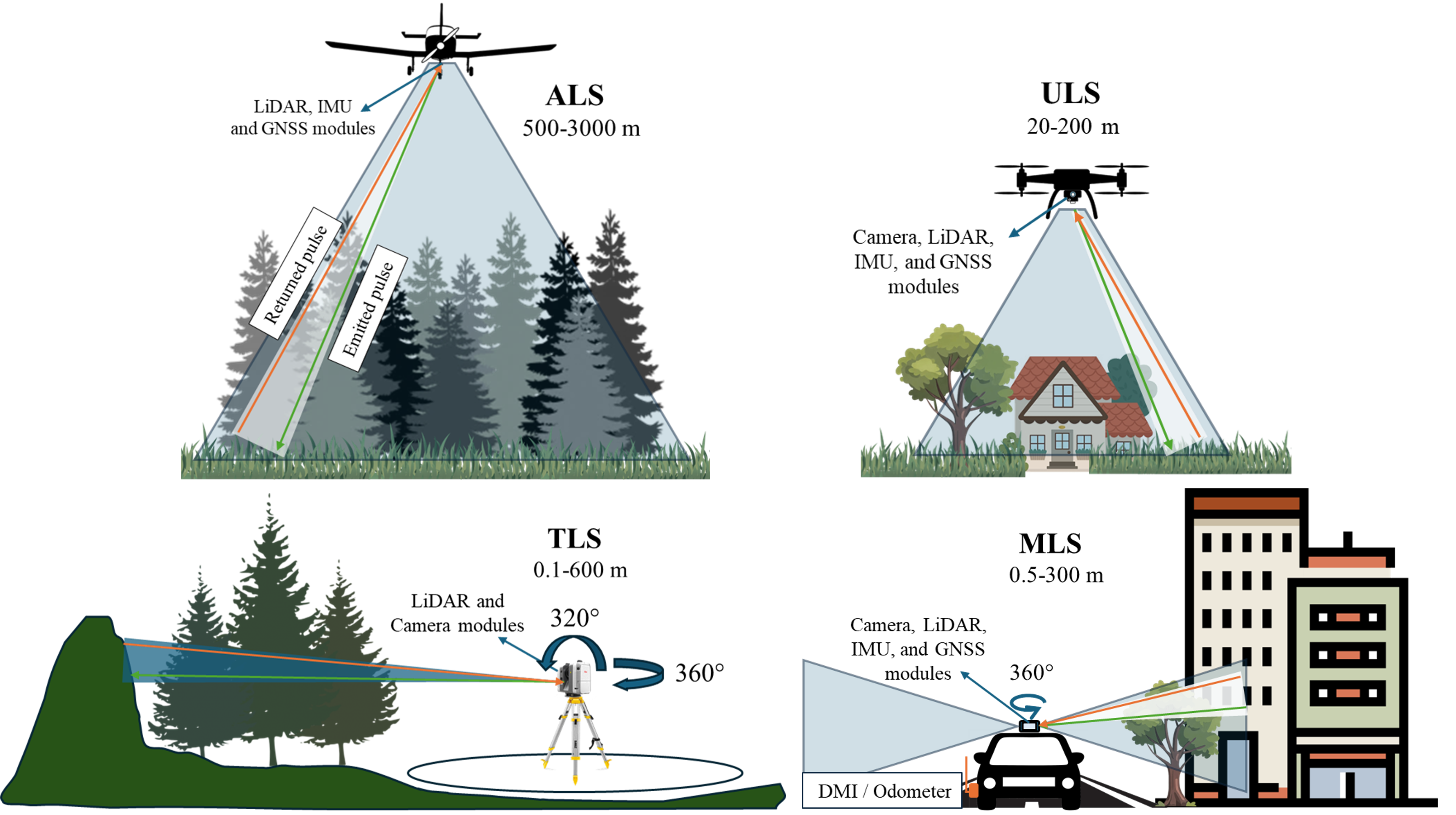
Developing a modular deep learning framework for high-resolution terrestrial LiDAR scans to automate semantic and instance segmentation of complex civil infrastructure components. The system integrates panoramic imagery projection, cross-modal supervision using Vision–Language Models (e.g., Grounded-SAM), and geometry-aware descriptors such as surface normals and point density. These capabilities support the creation of highly detailed Digital Twin models for structural analysis, FEM meshing, real-time asset monitoring, and long-term infrastructure management.
2024.08–Present: High-Fidelity Modeling and Deployment of a Digital Twin Building

thumbnail

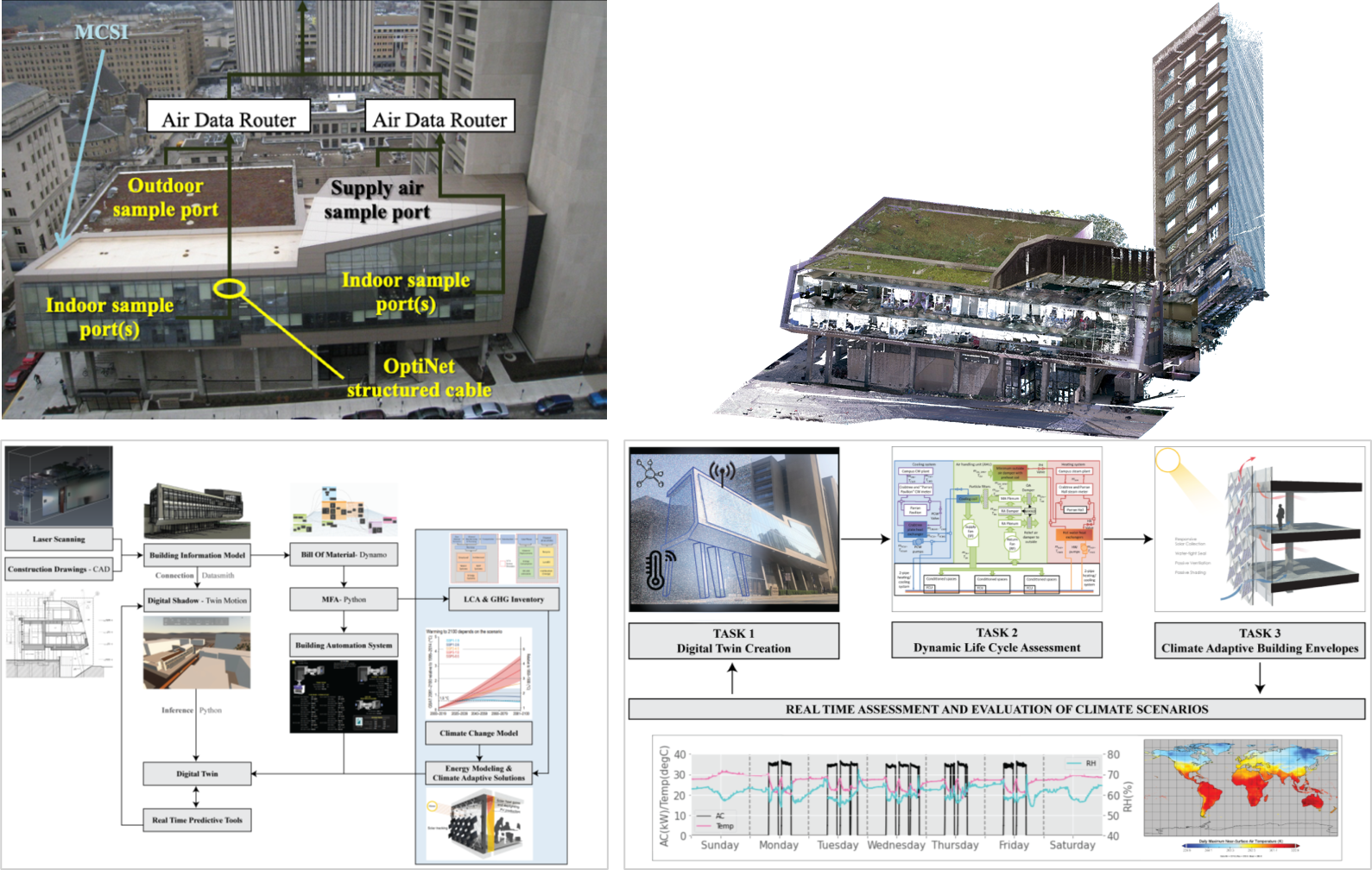
NSF-funded project aimed at creating a comprehensive Digital Twin of the Mascaro Center for Sustainable Innovation (MCSI) to advance climate-adaptive building design and sustainable operations. My work focuses on high-fidelity 3D modeling, BIM–LiDAR integration, and multi-source data fusion to support real-time monitoring, simulation, and decision-making in building performance management.

2023.04–2024.08: 3D Mesoscale Modeling of Concrete Consolidation and Packing Behavior

thumbnail

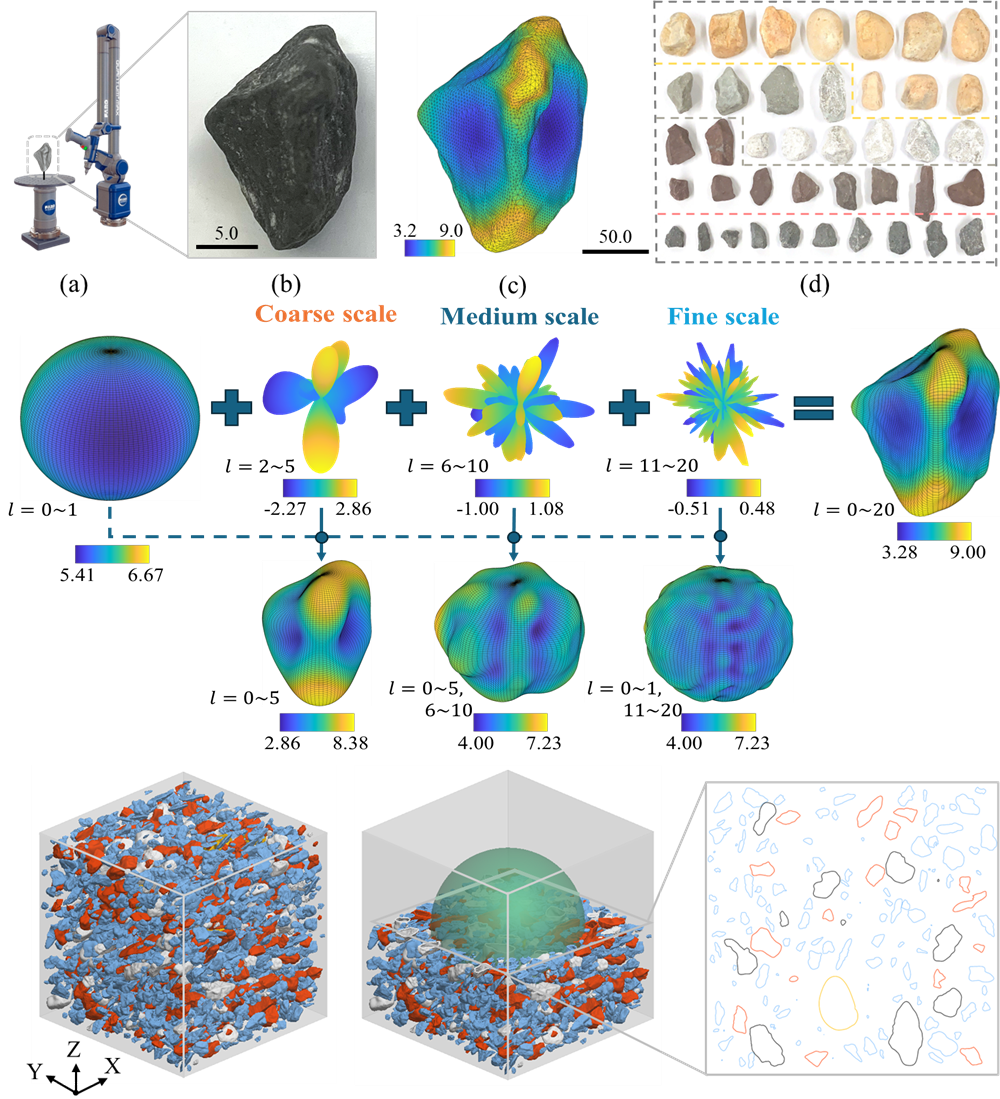
Established a physics-informed 3D mesoscale framework that combines spherical harmonic expansion, stochastic morphology generation, and DEM simulations to investigate aggregate packing and consolidation in slipform paving. The framework enables quantitative evaluation of vibratory energy transmission, aggregate distribution uniformity, and mortar–aggregate interactions under varying compaction conditions. This approach bridges experimental measurements with predictive modeling, providing a robust basis for optimizing construction parameters to achieve superior consolidation quality.

2022.08–2024.08: Computer Vision-Based Quality Control System for Slipform Paving

thumbnail

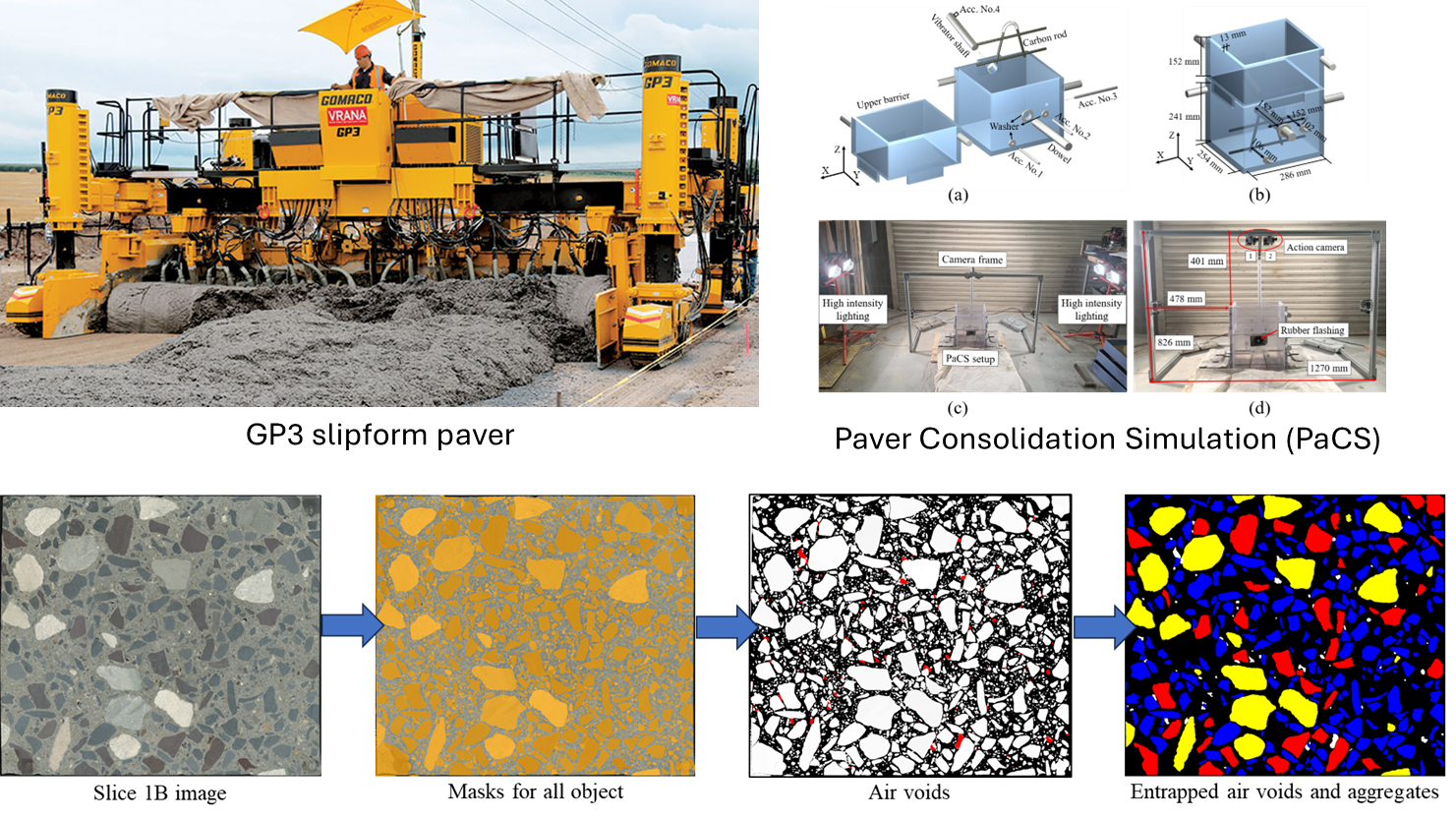
Designed and validated a real-time quality control system for slipform paving that integrates stereo vision, photometric stereo, and transformer-based segmentation to detect entrapped air voids and monitor aggregate distribution. The system was deployed in both laboratory and field environments, enabling high-resolution surface reconstruction and automated compliance with ASTM C457 air void analysis procedures. This work advances objective, data-driven evaluation of consolidation uniformity, reducing reliance on manual inspection and enhancing pavement durability.

2020.10–2022.08: Mechanical Evaluation of Lightweight Concrete with Core-Shell Structured Aggregates

thumbnail

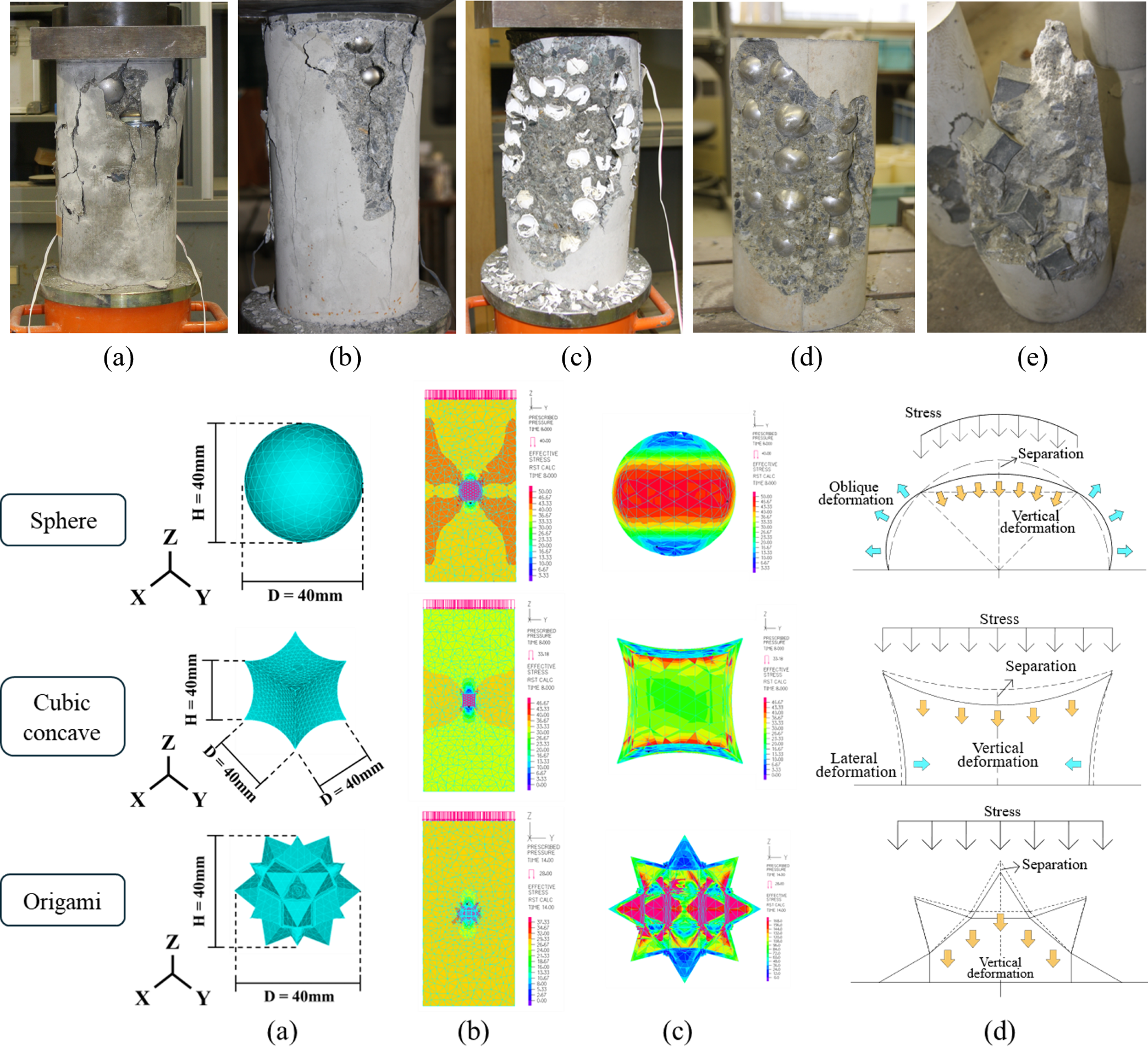
Advanced the design of lightweight concrete through the development of core-shell structured aggregates (CSA) that achieve substantial density reduction while maintaining high mechanical performance. The study combined nonlinear finite element simulations, particle swarm optimization, and large-scale experimental validation to investigate the influence of aggregate geometry, shell thickness, and material stiffness. Results provide actionable guidelines for mix design and manufacturing, supporting sustainable construction through reduced material consumption and improved structural efficiency.

publications

🔹 Experiments and Mechanical Simulation on Bubble Concrete: Studies on the Effects of Shape and Position of Hollow Bodies Mixed in Concrete

Yan, X., Chen, P. S., Al-Fakih, A., Liu, B., Mohammed, B. S., & Jin, J. (Crystals, 2021).

This paper proposes a new type of lightweight concrete called bubble concrete, which was developed by mixing concrete with high-strength hollow bodies. In the present study, concave and spherical steel hollow bodies were used not only to form multiple cavities in the concrete but also to transfer internal stresses. Through compression tests, the shape effects and distribution effects of the hollow bodies on the strength and Young’s modulus of concrete were investigated. In addition, the mechanical characteristics of the bubble concrete were simulated by nonlinear elastoplastic finite element analysis to study the stress distribution and failure mechanism. The results indicate that with the proper combination, bubble concrete can reduce its density to 1.971–2.003 g/cm3 (83.3–84.7%, compared to control concrete) and its strength reaches 27.536–28.954 N/mm2.

🔹 Effect of Hollow Body Shape on the Internal Stress Distribution of Bubble Concrete

Yan, X., & Chen, P. S. (ICAMC, 2021).

Bubble concrete is a lightweight achieved by mixing high-strength hollow bodies into concrete. Bubble concrete is different from biaxial voided slabs, it can reduce the density of concrete while ensuring the strength. As the existence of the hollow body will greatly affect the stress distribution inside the concrete , in order to improve the strength of the bubble concrete, this study conducted a nonlinear elastoplastic analysis with four different hollow body models. The optimal hollow body model is determined by comparing the stress distribution states inside the concrete. Based on the analytical results, as the capsule model inherits the good force transfer mechanism of the sphere, it can well reduce the lateral expansion of the hemisphere and further reduce the amount of concrete. Therefore, the capsule model is the best hollow body model for the bubble concrete in terms of stress distribution.

🔹 Approximate Equation for Estimating Global Buckling Load of Single-Layer Cylindrical Space Frames

Liu, B., Chen, P. S., Jin, J., & Yan, X. (AICCE, 2022).

This study proposes an approximate equation to evaluate the global buckling load of a single-layer cylindrical space frame without buckling analysis. In this research, large amounts of linear buckling analysis are carried out with various geometric parameters, and an imaginary stiffness G is proposed to represent the overall stiffness of the whole structure. Then, according to the influence of geometric parameters on buckling load factors and imaginary stiffness G, the authors derive an approximate equation based on regression analysis. Finally, the authors prove that the proposed approximate equations can evaluate the global buckling load in a high precision range.

🔹 Dynamic Properties and Seismic Performances of 1.5-Layer Space Frames with Lap-Units with Considering Vibration of Lower Joints

Jin, J., Chen, P. S., Liu, B., & Yan, X. (AICCE, 2022).

A new structural system called 1.5-layer space frame is proposed as the third member of the family of space frames, which may provide new design possibilities. The 1.5-layer space frames with lap-units are susceptible to deformation due to key part rotation about the axis of its upper chords. Therefore, it is necessary to capture the dynamic behaviors of the lower joints of the lap-units. Considering the vibration of lower joints, the main dynamic properties of four typical structures, including natural frequency and vibration mode shape are first examined, and the seismic performances are then assessed within the linear elastic range under selected earthquake excitations. To provide helpful information for practical design, the investigation on the relationship between structural properties and geometrical/design parameters is also conducted. As a result, the seismic response of the structures is significant when the depth-grid ratio (the ratio of web member and upper chord length) is greater than 0.5.

🔹 Effect of Hollow Bodies on the Strength and Density of Bubble Concrete

Yan, X., Chen, P. S., Mohammed, B. S., & Liu, B. (AICCE, 2022).

Bubble concrete is a new type of lightweight concrete achieved by mixing high-strength hollow bodies into concrete. Different from the stress mechanism of the voided biaxial slab, the hollow bodies are used not only to create multiple cavities in concrete but also to transfer internal stresses. To achieve a better strength of the specimen, this study investigates the arrangement and shape effects of the hollow bodies on the mechanical properties. In addition, a novel hollow body model was proposed to improve the stress distribution to increase strength and reduce density. The density, strength, and stiffness of three types of bubble concrete were investigated through concrete compression experiments. Then, the stress distribution and failure mechanism of the bubble concrete were explored with nonlinear elastoplastic analysis. The results show that the strength and density of bubble concrete with regular arrangement hollow bodies yielded better than the random arrangement. Furthermore, with the new hollow body models, the bubble concrete further increased the strength of concrete to 79.7–85.3% and reduced the density to 80.0–85.0%.

talks

TRB 103rd Annual Meeting

Presented the paper: Yan, X., Fascetti, A., Vandenbossche, J. M., & Darnell, M. (2023). *Computer Vision-Based Estimation of The Effects of Vibration in Slipform Paving. Transportation Research Record, 2678(11), 56–71. (Best Paper Award).

13th International Conference on Concrete Pavements (ICCP)

Presented the paper: Yan, X., Darnell, M. M., Vandenbossche, J. M., & Fascetti, A.* (2024). Deep Learning-Based Entrapped Air Segmentation and Evaluation (EASE) for Plain Concrete Pavement Applications. 13th ICCP. DOI:https://doi.org/10.33593/6d5dtd88.

TRB 104th Annual Meeting

Presented the paper: Yan, X., Darnell, M. M., Vandenbossche, J. M., & Fascetti, A.* (2025). Camera-Based Binocular Stereo Vision for Dynamic Assessment of Vibration Operations in Slipform Paving. Transportation Research Record, 0(0).

teaching

Teaching Assistant – CEE 1712/2713: Digitalization in Civil Engineering

Undergraduate/Graduate course, University of Pittsburgh, Swanson School of Engineering, 2025

Served as Teaching Assistant for CEE 1712/2713: Digitalization in Civil Engineering: From CAD to Virtual Reality, an advanced undergraduate/graduate course introducing digital workflows in civil engineering. Assisted Prof. Alessandro Fascetti in delivering lectures and hands-on recitations.