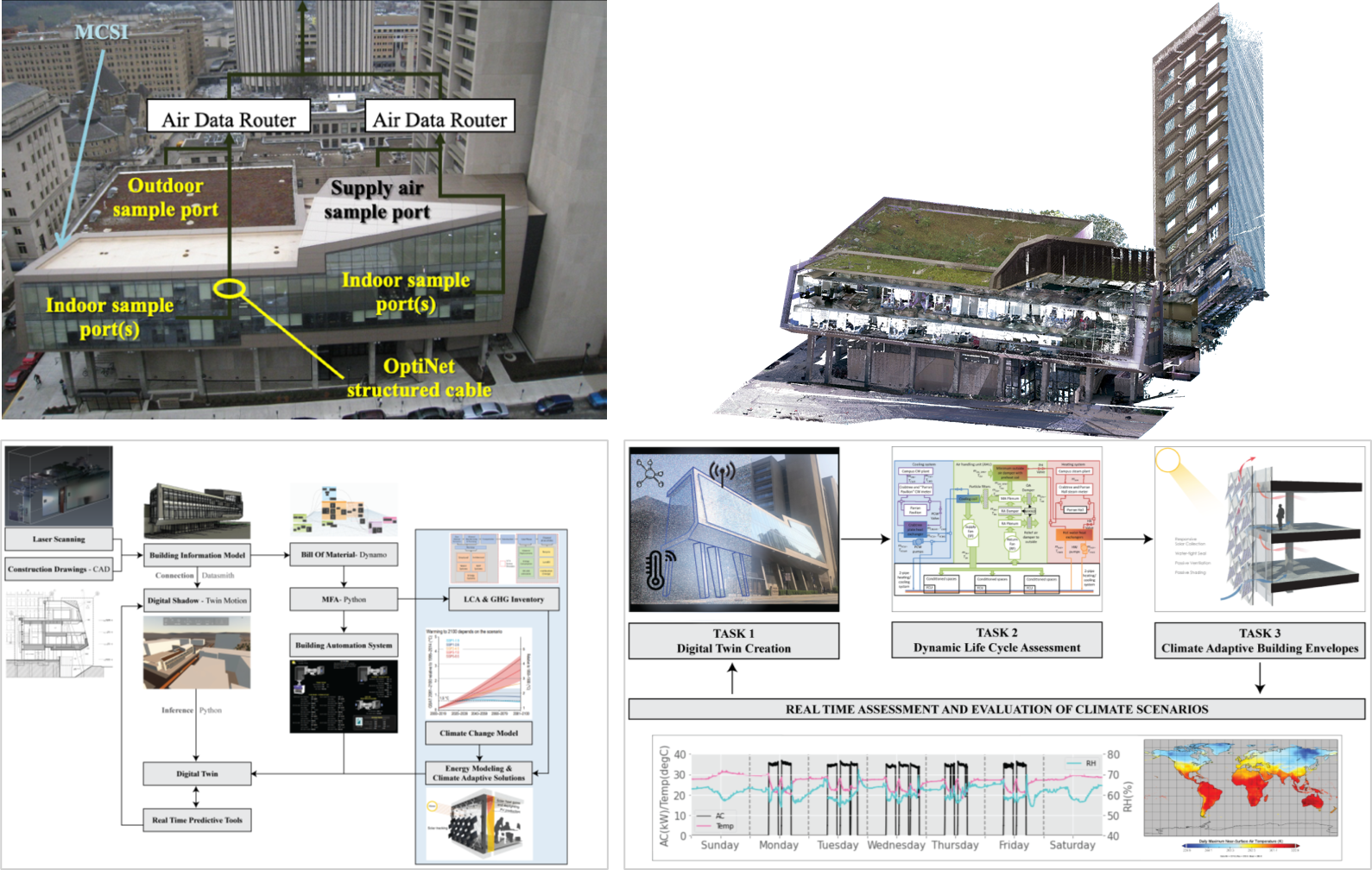
2024.08–Present: High-Fidelity Modeling and Deployment of a Digital Twin Building
Published:
Project Summary
This project develops a high-fidelity Digital Twin (DT) of the Mascaro Center for Sustainable Innovation (MCSI) at the University of Pittsburgh to model and optimize the energy and environmental performance of climate-adaptive buildings. My primary role is the Digital Twin Modeling, integrating multi-source data streams into a unified framework to support real-time assessment, visualization, and decision-making.
The framework combines high-resolution LiDAR-based reality capture with Building Information Modeling (BIM) and building automation system (BAS) sensor data (air quality, occupancy, energy use, water usage). These are harmonized into a six-layer Digital Twin architecture that enables predictive modeling under varying climate scenarios.
Objectives
- Create a high-resolution 3D reconstruction of the MCSI using terrestrial LiDAR and thermal imaging.
- Align and integrate BIM models with LiDAR point clouds using Dynamo scripting.
- Fuse real-time BAS sensor data with physics-based and data-driven models for energy, emissions, and comfort.
- Implement Dynamic Life Cycle Assessment (DLCA) to evaluate climate-change-driven impacts.
- Provide a scalable Digital Twin framework to inform climate-adaptive building design and sustainable operations.
Key Results (In Progress)
- Completed preliminary digital shadow of MCSI integrating LiDAR scans and BIM geometry.
- Established automated pipelines for BIM–point cloud subdivision and feature extraction.
- Integrated BAS sensor data into a live DT environment, enabling real-time visualization of environmental and energy performance.
- Designed multi-layer DT architecture incorporating physical twin, IoT connectivity, data repositories, and simulation tools (EnergyPlus, DLCA).
Related Publications
Yan, X., Fascetti, A., Bilec, M., Brigham, J. (in prep.). *High-Fidelity Digital Twin Modeling for Climate-Adaptive Buildings: Framework and Case Study of the MCSI Building. Target journal: Automation in Construction.
Funding
This project is funded by the National Science Foundation (NSF, Series number: CMMI-2232206) under the Climate-Adaptive Infrastructure Program. The funding supports the development of a multi-layer Digital Twin framework that integrates advanced sensing, reality capture, and simulation tools to enable sustainable operations and climate-resilient building design.
Visual Summary