2022.08–2024.08: Computer Vision-Based Quality Control System for Slipform Paving
Summary
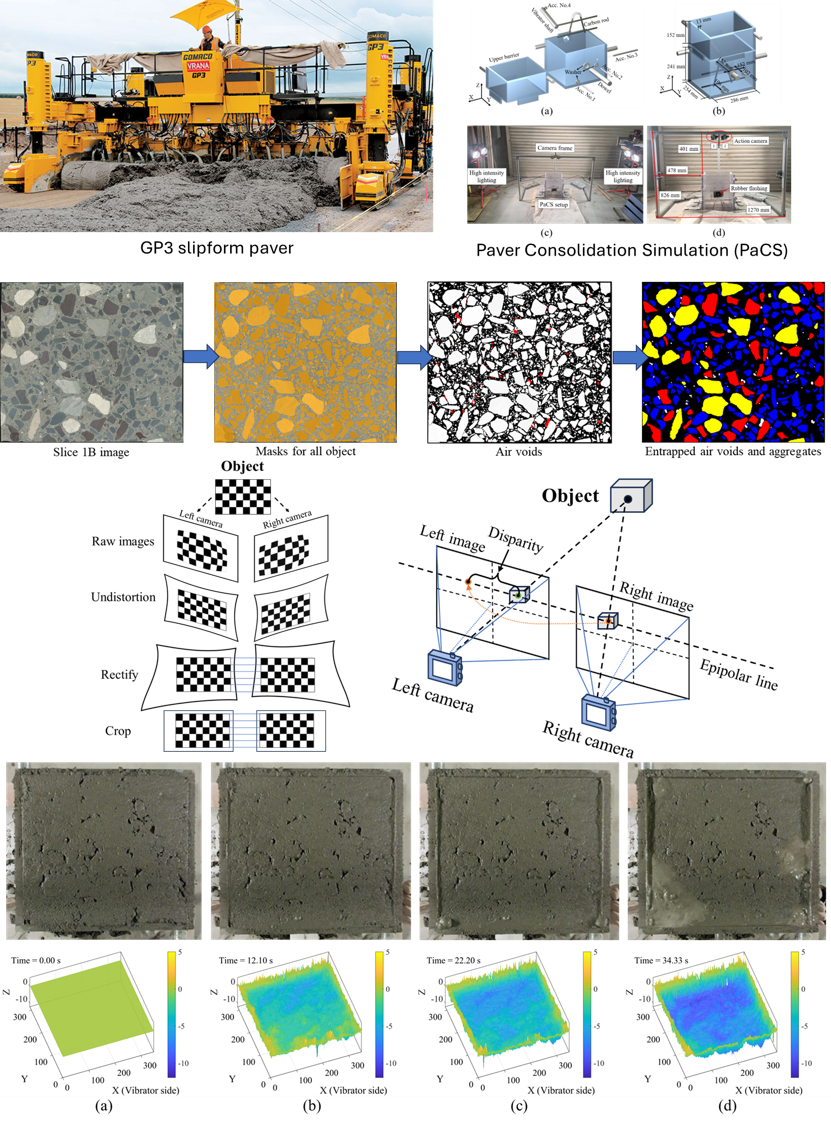
This project establishes a comprehensive, computer vision-based framework for non-invasive, real-time quality control of concrete consolidation in slipform paving. It combines a Paver Consolidation Simulator (PaCS) with stereo-vision, photometric stereo, and deep learning to evaluate the fluidization behavior of fresh concrete under vibration. The framework is designed to address limitations of manual inspections by enabling objective, automated tracking of entrapped air voids and aggregate spatial distribution.
A custom photometric stereo system and transformer-based image segmentation algorithm are developed to quantify air void content and distribution based on ASTM C457. The vision system evaluates how different vibration intensities influence concrete consolidation, enabling rapid feedback and optimization for construction engineers. Together, these innovations enhance QA/QC protocols for horizontal infrastructure, such as pavements and runways.
Objectives
- Build an instrumented platform (PaCS) to simulate slipform paving conditions in the lab.
- Evaluate the effect of vibration parameters on entrapped air distribution using stereo vision and accelerometers.
- Develop a Photometric Stereo–Vision Transformer framework for automating ASTM C457 air void analysis.
- Design real-time segmentation pipelines using Segment Anything Model (SAM) and geometric filtering.
- Validate air void analysis results against traditional petrographic reports and Procedure A/B from ASTM C457.
Key Results
- Designed and validated an 8-LED photometric stereo system capable of high-resolution void detection.
- Proposed a segmentation framework combining SAM, depth-guided filtering, and gradient masking to isolate voids.
- Achieved over 97% accuracy in void content and spacing factor estimation, benchmarked against petrographic analysis.
- Quantified the influence of vibration frequency and traverse spacing on void metrics through parametric sensitivity studies.
- Published experimental validation using both manual and automatic analysis on vibrated concrete specimens.
Related Publications
- Yan, X., Fascetti, A.* (2025). A Photometric Stereo and Vision Transformer-Based Framework for Automated Air Void Analysis in Hardened Concrete. Cement and Concrete Research. (Under Review)
- Yan, X., Darnell, M. M., Vandenbossche, J. M., & Fascetti, A.* (2025). Camera-Based Binocular Stereo Vision for Dynamic Assessment of Vibration Operations in Slipform Paving. Transportation Research Record.
- Yan, X., Darnell, M. M., Vandenbossche, J. M., & Fascetti, A.* (2024). Deep Learning-Based Entrapped Air Segmentation and Evaluation (EASE) for Plain Concrete Pavement Applications. 13th International Conference on Concrete Pavements (ICCP). Minnesota, USA.
- Yan, X., Fascetti, A., Vandenbossche, J. M., & Darnell, M. (2023). *Computer Vision-Based Estimation of The Effects of Vibration in Slipform Paving. Transportation Research Record, 2678(11), 56–71. (Best Paper Award)
Funding
This research is funded through the Improved Infrastructure Systems and Evaluation (IRISE) Consortium under the Year 4 and Year 6 Research Programs at the University of Pittsburgh, with additional support from the Pennsylvania Department of Transportation (PennDOT).
Visual Summary