2020.10–2022.08: Mechanical Evaluation of Lightweight Concrete with Core-Shell Structured Aggregates
Summary
This research explored the development of lightweight concrete incorporating Core-Shell Structured Aggregates (CSA), targeting an optimal balance between reduced density and retained mechanical strength. The work involved extensive experimental testing and finite element simulations to study the influence of aggregate shape, distribution, and material on mechanical performance.
A novel capsule-shaped CSA was designed and evaluated for its ability to reduce weight while maintaining structural integrity. Key findings showed that steel-based CCSA achieved a 16–19% density reduction while retaining up to 92% of compressive strength. The research demonstrates the feasibility of CSA-enhanced lightweight aggregate concrete for structural applications.
Objectives
- Design lightweight concrete incorporating core-shell structured aggregates (CSA) with reduced density and improved strength.
- Experimentally evaluate the mechanical response of CSA-enhanced concrete under compressive, tensile, and flexural loading.
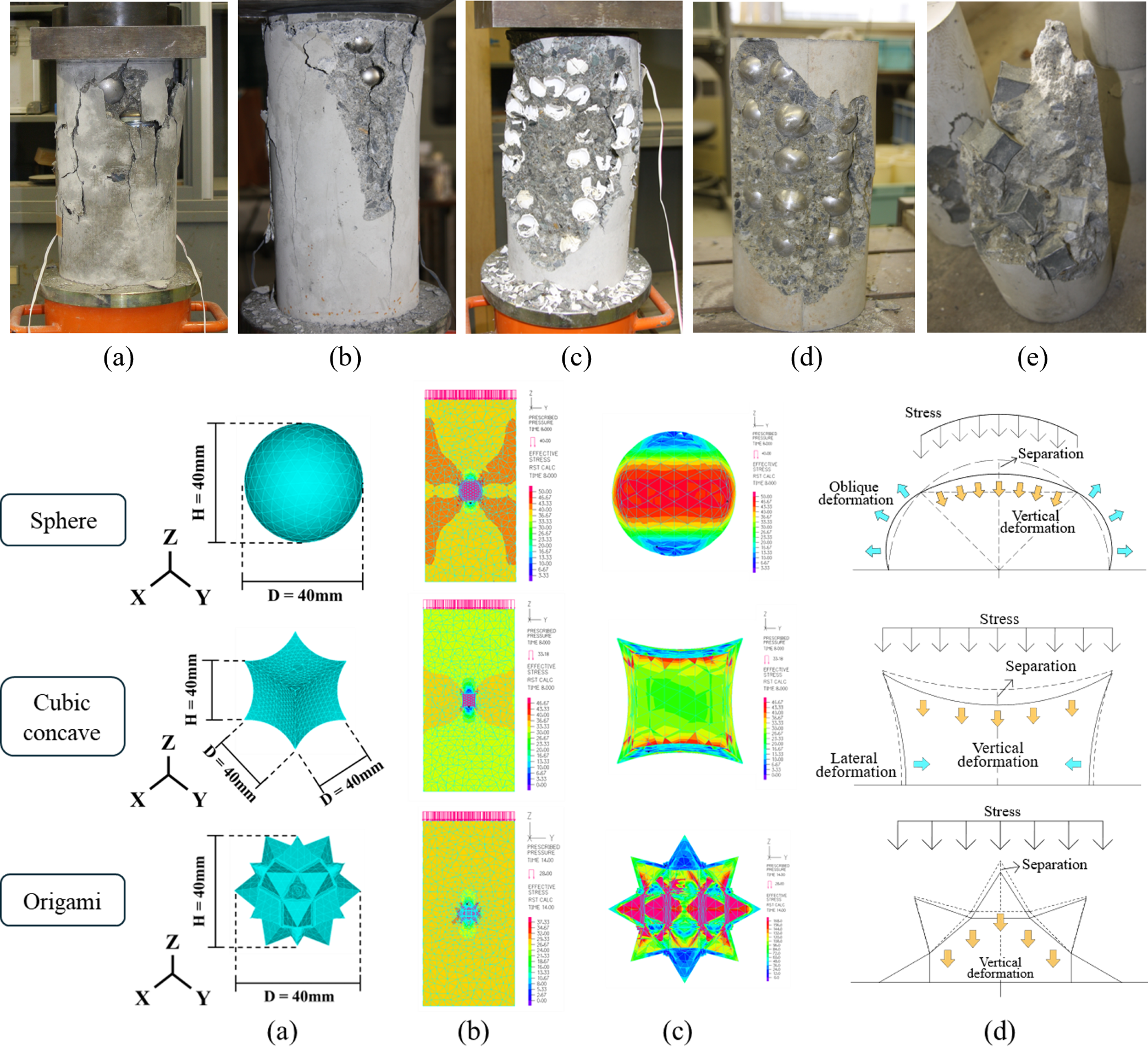
- Investigate the effect of hollow body shape, material type, and position on concrete consolidation and failure modes.
- Develop and validate a finite element modeling framework to simulate the stress distribution and mechanical efficiency of CSA geometries.
- Establish mix design recommendations for practical deployment of CSA in sustainable concrete applications.
Key Results
- Developed capsule-shaped CSA that significantly reduced density while preserving strength.
- Conducted full-scale experiments and finite element analysis for parameter optimization.
- Validated effectiveness of aggregate surface treatment in improving interfacial bonding and crack resistance.
Related Publications
- Yan, X., Chen, P. S., & Liu, B.* (2025). Mechanical evaluation of novel high-strength lightweight concrete with core-shell structured lightweight aggregate. Construction and Building Materials, 483, 141683. DOI
- Choo, J., Mohammed, B. S., Chen, P. S., Abdulkadir, I., & Yan, X. (2022). Modeling and Optimizing the Effect of 3D Printed Origami Bubble Aggregate on the Mechanical and Deformation Properties of Rubberized ECC. *Buildings, 12(12), 2201. DOI
- Yan, X., Chen, P. S., Liu, B., Mohammed, B. S., & Jin, J. (2022). Effect of Hollow Body Material on Mechanical Properties of Bubble Concrete. *Crystals, 12(5), 708. DOI
- Yan, X., Chen, P. S., Al-Fakih, A., Liu, B., Mohammed, B. S., & Jin, J. (2021). Experiments and mechanical simulation on bubble concrete: studies on the effects of shape and position of hollow bodies mixed in concrete. *Crystals, 11(8), 858. DOI
- Yan, X., Chen, P. S., Mohammed, B. S., & Liu, B. (2022, February). Effect of Hollow Bodies on the Strength and Density of Bubble Concrete. AWAM International Conference on Civil Engineering, 133-149. Springer Nature Singapore.
- Yan, X., & Chen, P. S. (2021, October). Effect of Hollow Body Shape on the Internal Stress Distribution of Bubble Concrete. International Conference on Architecture, Materials and Construction, 223-229. Springer.
Funding
This research was funded by the Special Research Supporting of Hachinohe Institute of Technology 2013, grant number: Tokutei-1. Joint Research Program between Kyushu Institute of Technology and Universiti Teknologi Petronas (2020–2022).
Visual Summary